

Part 2 of a three-part series on apologetics by Reid S. Monaghan.
In Part 1, we looked at what apologetics is and why it is helpful in the life of the church. As Jesus sends his people into the world to make disciples of all nations, Christians will always be engaging people in culture. The real question is what kind of engagement it will be.
Ask outsiders what they think of the church, and you will quickly discover that some of our engagement has been unthoughtful. People today have opinions of Christianity shaped by what they see online and in the media, what they hear from friends, the religion they were around growing up, and their personal interactions with Christians. Sometimes this gives the church a reputation that is hard to overcome.
Whether that reputation is deserved or not, we want to be wise in the way we engage with others. To do that, we will look first at Scripture and then at what we mean by culture. This will help us guide our people well as we train them to engage with the people around them.
Wisdom Toward Outsiders
Writing from prison, Paul gave the Colossian church a short but rich vision for engaging with people outside the faith:
“Continue steadfastly in prayer, being watchful in it with thanksgiving. At the same time, pray also for us, that God may open to us a door for the word, to declare the mystery of Christ, on account of which I am in prison—that I may make it clear, which is how I ought to speak. Walk in wisdom toward outsiders, making the best use of the time. Let your speech always be gracious, seasoned with salt, so that you may know how you ought to answer each person.”
Colossians 4:2–6
Think about what happened during Paul’s imprisonments. From his letter to the Philippians, we learn that the gospel became known throughout the whole imperial guard (Philippians 1:13). Even in chains, Paul prayed for open doors for the word, and God opened them.
Thoughtful engagement begins with prayer and watchfulness. Then it takes shape in three qualities of speech:
- Gracious. Our words should convey the grace we ourselves have received from God.
- Seasoned. Our words should have flavor and substance, drawing people in rather than driving them away.
- Answering. We should be ready to respond to each person, not with canned scripts, but with what suits that individual in a specific time and place.
Max Anders summarizes well what it means to walk in wisdom toward others:
“Wisdom enables us to combine boldness with tact. Wisdom enables us to employ the proper approach in specific situations and with particular individuals.”
Max Anders, Holman New Testament Commentary: Colossians
Those outside the church do not live in some culturally neutral place and time. People are shaped by many things we might call “culture.” So before we talk about cultural engagement, let’s look for a moment at what we mean by culture, so we can avoid some common problems.
What Is Culture?
If we are going to engage people in culture, we need to understand what culture is. Joshua Chatraw and Karen Swallow Prior offer a helpful starting point:
“Engaging culture, rightly conceived, includes studying the world around us—to understand its aspirations, longings, institutions, artifacts, ideas, and issues—in order to better engage the people within cultures.”
Joshua Chatraw and Karen Swallow Prior, Cultural Apologetics, 21
Here is the distinction I want you to see: culture is not some amorphous blob we engage by watching a lot of movies and observing art. The goal of cultural fluency is to “better engage the people within cultures.”
Anthropologist Clifford Geertz described culture as “a historically transmitted pattern of meanings embodied in symbols, a system of inherited conceptions expressed in symbolic forms by means of which men communicate, perpetuate, and develop their knowledge about and attitudes toward life” (The Interpretation of Cultures, 89). To know a culture is to hope to know the people who live in it.
Kevin Vanhoozer adds that culture is made up of “works” and “worlds” of meaning. It is a work because it is what humans freely make when they “work the raw material of nature to produce something significant.” It is a world because cultural texts “create a meaningful environment in which humans dwell both physically and imaginatively.” Culture is, in his words, “a lived worldview” (Everyday Theology, 26).
So here is the key point: we do not engage “it.” We engage people in it. Culture is not an abstraction simply to be debated or defeated. It is the water our neighbors swim in and the air they breathe. We study culture so we can understand and love the people being formed by it, and share the gospel with them in a thoughtful way.
An Important Caution
In certain communities of Christians, culture can become the dominant force that overrides everything. We must not be led into believing that culture makes truth and morality relative to people’s cultural proclivities. Engaging people with cultural awareness does not mean being governed by culture. Our lives are submitted first to God and his Word.
Christian cultural critic and apologist Os Guinness sounds the warning well in Prophetic Untimeliness: A Challenge to the Idol of Relevance:
“For all the lofty recent statements on biblical authority, a great part of the evangelical community has made an historic shift. It has transferred authority from Sola Scriptura (by scripture alone) to Sola Cultura (by culture alone).”
Os Guinness, Prophetic Untimeliness
We study culture to understand people, not to let culture sit in judgment over the truth of God’s Word. We must never forget that revealed truth is true.
Many of the intellectual currents around us quietly undermine the possibility of even knowing truth. Some approaches to the sociology of knowledge, or viewpoint epistemology, suggest that what we “know” is merely a product of our social, cultural, and temporal location. Reader-response approaches to interpretation place meaning in the reader rather than in the author or the text, God included. On that view, the Bible cannot convey meaning of its own; it can only mean something “to us,” depending on our culture.
We can affirm that readers rightly apply Scripture in many ways while holding firmly that God has spoken, and that what he has spoken is true. God speaks from outside of people and culture to all of us who are situated within it. That gives us a reference point of truth for understanding our culture, and the right authority from which to offer critique and correction.
Where Life and Mission Take Place
Thoughtful engagement and the use of apologetics do not happen only on stages, in debates, or while jousting in the comment sections of the internet at two in the morning. They happen in the ordinary spheres of life where God has placed us.
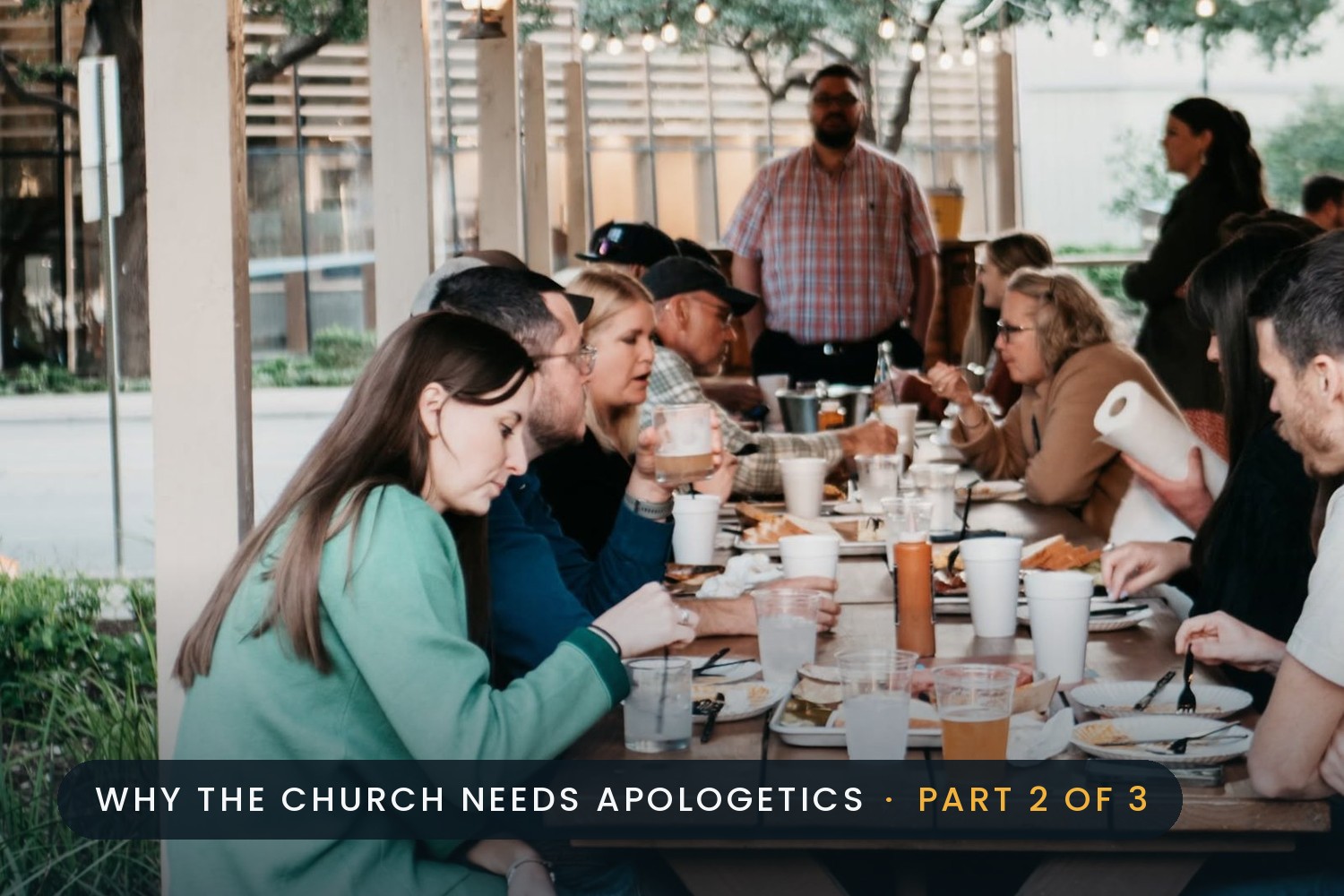
We live out his mission in three primary spheres: the home, the church, and the city. Each has a culture of its own, and each shapes us as human beings. Over time, more and more of our engagement will take place outside the home and church, out in the city. For parents and pastors, each of these spaces matters and will shape your people. Form them well along the way.
The Home. Paul’s instructions to husbands and wives, parents and children (Ephesians 5–6) remind us that the home is a primary place of discipleship and cultural formation. At Pentecost, Peter proclaimed, “For the promise is for you and for your children and for all who are far off, everyone whom the Lord our God calls to himself” (Acts 2:39). Our first apologetic audience is often at our own dinner table, or in the car on the way to a baseball game or soccer tournament. Teaching our kids and answering their questions will help them step into the broader world being formed in Christ.
The Church. “So then you are no longer strangers and aliens, but you are fellow citizens with the saints and members of the household of God” (Ephesians 2:19). The church is a family where questions should be welcomed and answered, and where we are equipped to do good to others, “especially to those who are of the household of faith” (Galatians 6:10; see also 1 Peter 4:17). A church should not discourage the pursuit of truth but guide it well. Training in apologetics and engagement can be offered to every age group. If we keep mission before our people, they will have questions as they engage with others.
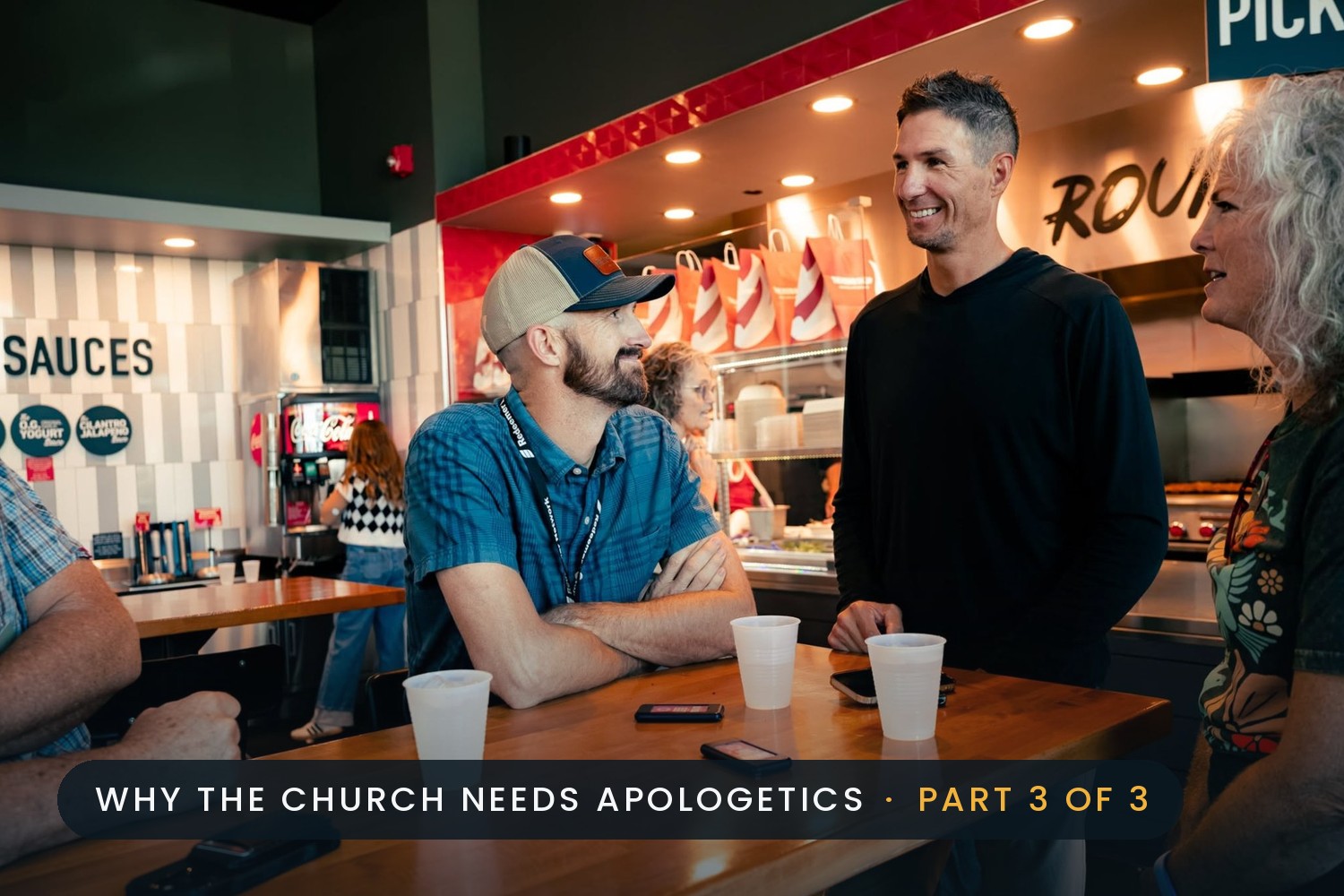
The City. God’s purpose is for his people to reach outward: “I will give you as a covenant for the people, a light for the nations, to open the eyes that are blind, to bring out the prisoners from the dungeon, from the prison those who sit in darkness” (Isaiah 42:6–7). Our workplaces, neighborhoods, sports fields, campuses, locker rooms, schools, and coffee shops are places where that light is meant to shine.
The Questions Our Neighbors Are Asking
Alongside the classic questions of Christian apologetics, such as the existence of God, the reliability of the Bible, and the resurrection of Jesus, our post-Christian neighbors are wrestling with pressing cultural questions. In 2026, those include, but are not limited to:
- Political engagement
- Racism and tribalism
- Truth, lies, and misinformation
- Gender and human sexuality
- Environmental concerns
- Aliens and interstellar life
- Technology and artificial intelligence
Each of these is more than a topic to debate. These are issues that stir people’s hopes, fears, loves, and longings. Behind each one are people with aspirations and assumptions about the meaning of life, what is good for people, and how we should live. Thoughtful engagement means listening long enough to understand those longings, and then showing how the gospel of Jesus Christ speaks to them more truly and more beautifully than any rival story.
We will not always have the perfect answer ready in our back pocket. But we can pray for open doors, watch for them, and walk through them with wisdom as the Holy Spirit leads. We can study our cultural moment in order to love the people in it. We can stand firmly on God’s revealed truth while speaking with grace. And wherever God places us, in our homes, our churches, and our cities, we can live this way to lift Jesus high so that many might hear the gospel and believe.
More in Part 3: How to Share Your Faith Without Starting an Argument, a practical framework to help your people live a life of real witness in a culture of confusion.

About the Author
Reid Monaghan
Reid Monaghan is the founder and President of The Gospel Underground. He has over 30 years of ministry experience working with university students and athletes, as well as a dozen years in pastoral ministry, church planting, and entrepreneurial leadership. He also serves as the Director of Church Planting for the Redeemer Network.